
As Demand for Trade Workers Grows, Women Completing Training at NCUS TEC Prepare to Power the Workforce
For generations, manufacturing floors and construction sites have been viewed as territory reserved for men. Today, these industries are scrambling to fill roles as worker shortages have hit historic highs. A perfect storm of booming construction and infrastructure projects, an aging workforce, and a scarcity of younger, skilled talent is driving this urgent need.

According to the U.S. Bureau of Labor Statistics, women represent 11 to 12 percent of the nation’s construction workforce and 29 percent of the manufacturing workforce.
“One of the challenges our industry faces is the fact we have not been able to successfully recruit more women into the industry,” said Brian Turmail, Vice President of Marketing, Communications, Fundraising & Market Insights at Associated General Contractors of America. “That is one of the main reasons why we developed AGC of America’s Culture of CARE program.”
The Culture of CARE program is designed to help firms create more welcoming and inclusive job sites to better recruit and retain workers from underrepresented communities more effectively, particularly in construction. Supporting the program is a federal initiative, the U.S. Department of Commerce’s Million Women in Construction, aimed at boosting female representation in the construction trades.
One of the largest construction companies in the U.S., Turner Construction Company, signed the Department of Commerce’s Million Women in Construction Community Pledge.
“Closing the workforce gap requires strong partnerships between industry and training providers that prepare women with the technical skills and credentials needed to succeed in high-demand careers,” said Vanessa Jester, director of community and citizenship, Turner Construction. “NCUS TEC is one example of an institution creating pathways by equipping women and underrepresented communities with industry-recognized training that leads directly into opportunities in construction and related trades.”
NCUS TEC, a technical and career training institution headquartered in Columbus, Ohio, with locations throughout the state and in Pennsylvania. The institution actively recruits and enrolls women in accelerated workforce development programs, including Industry 4.0 credentials, to equip students for in-demand, high-growth careers.
Prior to joining Turner Construction, Jester served as vice president of the National Center for Urban Solutions (NCUS), the parent company of NCUS TEC.
She noted that her experience at NCUS strengthened her ability to build programs that develop pipelines from untapped communities and lead inclusion-centered initiatives aligned with Turner’s 2030 vision and signature diversity efforts, including the Million Women in Construction Pledge.
“I took NCUS TEC’s program that trains people in the fiber optics and construction,” said Sydnie Wilkins, NCUS TEC graduate.
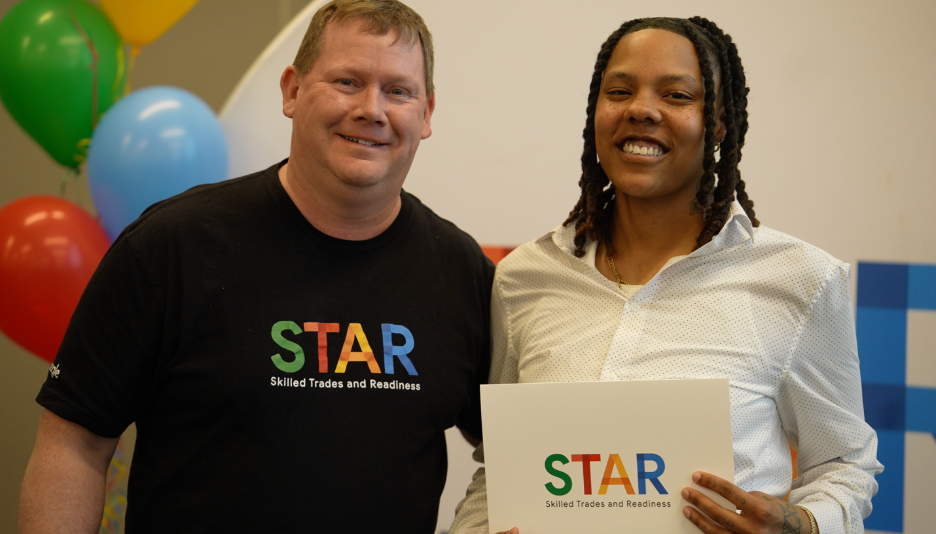
Wilkins secured a job at E2 Optics, an employer partner of NCUS TEC, as an installer.
She described her transition from working in healthcare to information and communication technology, an industry predominantly male, as difficult.
“As a woman in a male-dominated industry, you really have to stand your ground, but NCUS TEC gave me the tools to do just that,” said Wilkins.
Nine out of ten NCUS TEC graduates secure employment in high-demand fields. The organization leverages a robust workforce partner model to ensure students successfully transition from the classroom to high-paying, in-demand careers.
NCUS TEC serves as one of the workforce pipelines helping address the very challenge Turmail describes. By providing accelerated, industry-aligned training in construction, advanced manufacturing, and emerging technologies, the Columbus-based institution prepares women and underrepresented workers with the technical skills, certifications, and hands-on experience needed to enter and advance in high-demand trades.
Through partnerships with employers and workforce organizations, NCUS TEC is helping translate recruitment goals into job-ready talent, expanding access to careers in industries actively seeking to diversify and strengthen their workforce.